1110 stories
·
0 followers

Could Home-Building Robots Help Fix the Housing Crisis?

1 Share
CNN reports on a company called Automated Architecture (AUAR) which makes "portable" micro-factories that use a robotic arm to produce wooden framing for houses (the walls, floors and roofs): Co-founder Mollie Claypool says the micro-factories will be able to produce the panels quicker, cheaper and more precisely than a timber framing crew, freeing up carpenters to focus on the construction of the building... The micro-factory fits into a shipping container which is sent to the building site along with an operator. Inside the factory, a robotic arm measures, cuts and nails the timber into panels up to 22 feet (6.7 meters) long, keeping gaps for windows and doors, and drilling holes for the wiring and plumbing. The contractor then fits the panels by hand. One micro-factory can produce the panels for a typical house in about a day — a process which, according to Claypool, would take a normal timber framing crew four weeks — and is able to produce framing for buildings up to seven stories tall... She says their service is 30% cheaper than a standard timber framing crew, and up to 15% cheaper than buying panels from large factories and shipping them to a site... She adds that the precision of the micro-factories means that the panels fit together tightly, reducing the heat loss of the final home, making them more energy efficient. AUAR currently has three micro-factories operating in the US and EU, with five more set to be delivered this year... AUAR has raised £7.7 million ($10.3 million) to date, and is expanding into the US, where a lack of housing and preference for using wood makes it a large potential market. There's other companies producing wooden or modular housing components, the article points out. But despite the automation, the company's co-founder insists to CNN that "Automation isn't replacing jobs. Automation is filling the gap." The UK's Construction Industry Training Board found that the country will need 250,000 more workers by 2028 to meet building targets but in 2023, more people left the industry than joined.

Read more of this story at Slashdot.

Read the whole story
Share this story
Delete

Judges Find AI Doesn't Have Human Intelligence in Two New Court Cases

1 Share
Within the last month two U.S> judges have effectively declared AI bots are not human, writes Los Angeles Times columnist Michael Hiltzik: On Monday, the Supreme Court declined to take up a lawsuit in which artist and computer scientist Stephen Thaler tried to copyright an artwork that he acknowledged had been created by an AI bot of his own invention. That left in place a ruling last year by the District of Columbia Court of Appeals, which held that art created by non-humans can't be copyrighted... [Judge Patricia A. Millett] cited longstanding regulations of the Copyright Office requiring that "for a work to be copyrightable, it must owe its origin to a human being"... She rejected Thaler's argument, as had the federal trial judge who first heard the case, that the Copyright Office's insistence that the author of a work must be human was unconstitutional. The Supreme Court evidently agreed... [Another AI-related case] involved one Bradley Heppner, who was indicted by a federal grand jury for allegedly looting $150 million from a financial services company he chaired. Heppner pleaded innocent and was released on $25-million bail. The case is pending.... Knowing that an indictment was in the offing, Heppner had consulted Claude for help on a defense strategy. His lawyers asserted that those exchanges, which were set forth in written memos, were tantamount to consultations with Heppner's lawyers; therefore, his lawyers said, they were confidential according to attorney-client privilege and couldn't be used against Heppner in court. (They also cited the related attorney work product doctrine, which grants confidentiality to lawyers' notes and other similar material.) That was a nontrivial point. Heppner had given Claude information he had learned from his lawyers, and shared Claude's responses with his lawyers. [Federal Judge Jed S.] Rakoff made short work of this argument. First, he ruled, the AI documents weren't communications between Heppner and his attorneys, since Claude isn't an attorney... Second, he wrote, the exchanges between Heppner and Claude weren't confidential. In its terms of use, Anthropic claims the right to collect both a user's queries and Claude's responses, use them to "train" Claude, and disclose them to others. Finally, he wasn't asking Claude for legal advice, but for information he could pass on to his own lawyers, or not. Indeed, when prosecutors tested Claude by asking whether it could give legal advice, the bot advised them to "consult with a qualified attorney." The columnist agrees AI-generated results shouldn't receive the same protections as human-generated material. "The AI bots are machines, and portraying them as though they're thinking creatures like artists or attorneys doesn't change that, and shouldn't." He also seems to think their output is at best second-hand regurgitation. "Everything an AI bot spews out is, at more than a fundamental level, the product of human creativity."

Read more of this story at Slashdot.

Read the whole story
Share this story
Delete

How Anthropic's Claude Helped Mozilla Improve Firefox's Security

1 Share
"It took Anthropic's most advanced artificial-intelligence model about 20 minutes to find its first Firefox browser bug during an internal test of its hacking prowess," reports the Wall Street Journal. The Anthropic team submitted it, and Firefox's developers quickly wrote back: This bug was serious. Could they get on a call? "What else do you have? Send us more," said Brian Grinstead, an engineer with Mozilla, Firefox's parent organization. Anthropic did. Over a two-week period in January, Claude Opus 4.6 found more high-severity bugs in Firefox than the rest of the world typically reports in two months, Mozilla said... In the two weeks it was scanning, Claude discovered more than 100 bugs in total, 14 of which were considered "high severity..." Last year, Firefox patched 73 bugs that it rated as either high severity or critical. A Mozilla blog post calls Firefox "one of the most scrutinized and security-hardened codebases on the web. Open source means our code is visible, reviewable, and continuously stress-tested by a global community." So they're impressed — and also thankful Anthropic provided test cases "that allowed our security team to quickly verify and reproduce each issue." Within hours, our platform engineers began landing fixes, and we kicked off a tight collaboration with Anthropic to apply the same technique across the rest of the browser codebase... . A number of the lower-severity findings were assertion failures, which overlapped with issues traditionally found through fuzzing, an automated testing technique that feeds software huge numbers of unexpected inputs to trigger crashes and bugs. However, the model also identified distinct classes of logic errors that fuzzers had not previously uncovered... We view this as clear evidence that large-scale, AI-assisted analysis is a powerful new addition in security engineers' toolbox. Firefox has undergone some of the most extensive fuzzing, static analysis, and regular security review over decades. Despite this, the model was able to reveal many previously unknown bugs. This is analogous to the early days of fuzzing; there is likely a substantial backlog of now-discoverable bugs across widely deployed software. "In the time it took us to validate and submit this first vulnerability to Firefox, Claude had already discovered fifty more unique crashing inputs" in 6,000 C++ files, Anthropic says in a blog post (which points out they've also used Claude Opus 4.6 to discover vulnerabilities in the Linux kernel). "Anthropic "also rolled out Claude Code Security, an automated code security testing tool, last month," reports Axios, noting the move briefly rattled cybersecurity stocks...

Read more of this story at Slashdot.

Read the whole story
Share this story
Delete

Workers Who Love 'Synergizing Paradigms' Might Be Bad at Their Jobs

1 Share
Cornell University makes an announcement. "Employees who are impressed by vague corporate-speak like 'synergistic leadership,' or 'growth-hacking paradigms' may struggle with practical decision-making, a new Cornell study reveals." Published in the journal Personality and Individual Differences, research by cognitive psychologist Shane Littrell introduces the Corporate Bullshit Receptivity Scale (CBSR), a tool designed to measure susceptibility to impressive-but-empty organizational rhetoric... Corporate BS seems to be ubiquitous - but Littrell wondered if it is actually harmful. To test this, he created a "corporate bullshit generator" that churns out meaningless but impressive-sounding sentences like, "We will actualize a renewed level of cradle-to-grave credentialing" and "By getting our friends in the tent with our best practices, we will pressure-test a renewed level of adaptive coherence." He then asked more than 1,000 office workers to rate the "business savvy" of these computer-generated BS statements alongside real quotes from Fortune 500 leaders... The results revealed a troubling paradox. Workers who were more susceptible to corporate BS rated their supervisors as more charismatic and "visionary," but also displayed lower scores on a portion of the study that tested analytic thinking, cognitive reflection and fluid intelligence. Those more receptive to corporate BS also scored significantly worse on a test of effective workplace decision-making. The study found that being more receptive to corporate bullshit was also positively linked to job satisfaction and feeling inspired by company mission statements. Moreover, those who were more likely to fall for corporate BS were also more likely to spread it. Essentially, the employees most excited and inspired by "visionary" corporate jargon may be the least equipped to make effective, practical business decisions for their companies.

Read more of this story at Slashdot.

Read the whole story
Share this story
Delete

Study shows how rocket launches pollute the atmosphere

1 Share

New research published Thursday bolsters growing concerns that a handful of companies and countries are using the global atmospheric commons as a dumping ground for potentially toxic and climate-altering industrial waste byproducts from loosely regulated commercial space flights.

The new study analyzed a plume of pollution trailing part of a Falcon rocket that crashed through the upper atmosphere on Feb. 19, 2025, after SpaceX lost control of its reentry. The rocket was launched earlier that month, carrying 20 to 22 Starlink satellites into orbit.

The authors said it is the first time debris from a specific spacecraft disintegration has been traced and measured in the near-space region about 80 to 110 kilometers above Earth. Changes there can affect the stratosphere, where ozone and climate processes operate. Until recent years, human activities had little impact in that region.

Element-specific monitoring could be part of a broader effort to track how re-entry emissions spread and accumulate, the researchers noted, giving policymakers a chance to understand and manage the growing atmospheric footprint of spaceflight.

“I was surprised how big the event was, visually,” lead author Robin Wing, a researcher at the Leibniz Institute of Atmospheric Physics, said via email. He said people across northern Europe captured images of the burning debris, which was concentrated enough to enable high-resolution observations and to use atmospheric models to trace the lithium to its source.

The study shows that instruments can detect rocket pollution “in the ‘Ignorosphere’ (upper atmosphere near space),” he wrote. “There is hope that we can get ahead of the problem and that we don’t run blind into a new era of emissions from space.”

SpaceX did not immediately respond to questions or requests for comment from Inside Climate News.

A 2024 report from the United Nations University found that the rapid growth of commercial space activity is outpacing unevenly followed and voluntary guidelines. Without more global monitoring and collaboration, the rising demand for satellite launches will accelerate pollution risks in the shared space environment, the report warned.

International agreements covering rocket pollution include the Outer Space Treaty and Liability Convention. They require countries to avoid harmful contamination and to accept responsibility for damage caused by their space objects. Those principles are reflected by several International Court of Justice rulings and opinions on preventing cross-border environmental harm. Debris and atmospheric pollution from space launches disperses globally, affecting many nations that do not launch rockets at all.

Potential climate impacts

Research led by scientists with the National Oceanic and Atmospheric Administration, published in 2025, concluded that emissions from disintegrated satellites are likely to increase sharply in the coming decades. Some projections suggest as many as 60,000 satellites could be in orbit by 2040, with reentries every one to two days, injecting up to 10,000 metric tons of aluminum oxide particles into the upper atmosphere each year.

The study found that those aerosols could warm parts of the upper atmosphere by about 1.5 degrees Celsius within one or two years of reaching that number of satellites. That could alter winds and ozone chemistry, and persist for years, indicating a rapidly growing human-made source of pollution at the highest levels of the atmosphere.
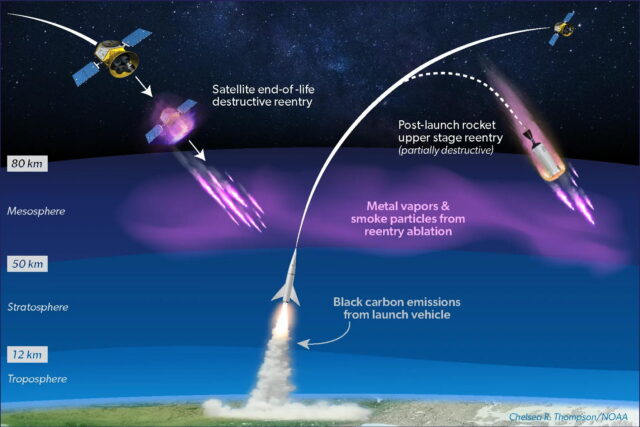
Illustration of different layers of Earth's atmosphere The various layers of Earth’s atmosphere and how satellites vaporize as they hit the mesosphere at the end of their lifetimes. This process seeds the middle and upper atmosphere with metal vapors, aerosols, and smoke particles. The mesosphere is also where naturally occurring meteors vaporize. The ozone layer lies within the stratosphere. Credit: Chelsea Thompson/NOAA

Those particles matter because they act like other catalytic aerosols in the upper atmosphere. Aluminum oxide dust from burning spacecraft absorbs and scatters sunlight and can warm areas where it accumulates. That can subtly change atmospheric circulation, the researchers noted. As the particles drift and settle lower into the stratosphere, they can affect ozone chemistry and high-altitude clouds, altering how sunlight and heat move through the atmosphere and potentially influencing climate over time.

The potential scope of impacts from space activities was outlined by several researchers at the 2025 European Geosciences Union conference in Vienna. They said that, beyond orbital debris, the booming space industry is the source of a new form of atmospheric pollution, injected directly into the layers of air that protect the planet and regulate its climate.

Atmospheric scientist Laura Revell, with the University of Canterbury in New Zealand, presented research showing that rocket exhaust in the atmosphere can erase some of the hard-won gains in mitigating ozone depletion.

In a high-growth scenario for the space industry, there could be as many as 2,000 launches per year, which her modeling shows could result in about 3 percent ozone loss, equal to the atmospheric impacts of a bad wildfire season in Australia. She said most of the damage comes from chlorine-rich solid rocket fuels and black carbon in the plumes.

The black carbon could also warm parts of the stratosphere by about half-a-degree Celsius as it absorbs sunlight. That heats the surrounding air and can shift winds that steer storms and areas of precipitation.

“This is probably not a fuel type that we want to start using in massive quantities in the future,” she added.

Researchers at the conference estimated that in the past five years, the mass of human‑made material injected into the upper atmosphere by re‑entries has doubled to nearly a kiloton a year. For some metals like lithium, the amount is already much larger than that contributed by disintegrating meteors.

In the emerging field of space sustainability science, researchers say orbital space and near-space should be considered part of the global environment. A 2022 journal article co-authored by Moriba Jah, a professor of aerospace engineering and engineering mechanics at the University of Texas at Austin, argued that the upper reaches of the atmosphere are experiencing increased impacts from human activities.

The expanding commercial use of what appears to be a free resource is actually shifting its real costs onto others, the article noted.

At last year’s European Geosciences Union conference, Leonard Schulz, who studies space pollution at the Technical University Braunschweig in Germany, said, “If you put large amounts of catalytic metals in the atmosphere, I immediately think about geoengineering.”

There may not be time to wait for more scientific certainty, Schulz said: “In 10 years, it might be too late to do anything about it.”

Bob Berwyn is an Austria-based reporter who has covered climate science and international climate policy for more than a decade. Previously, he reported on the environment, endangered species and public lands for several Colorado newspapers, and also worked as editor and assistant editor at community newspapers in the Colorado Rockies.

This story originally appeared on Inside Climate News.

Read full article

Comments


Read the whole story
Share this story
Delete

Fishing crews in the Atlantic keep accidentally dredging up chemical weapons

1 Share

Until 1970, the US dumped an estimated 17,000 tons of unspent chemical weapons from World War I and II off the coast of the Atlantic Ocean—and that disposal decision continues to haunt commercial fishing operations.

In an article published this week in the Morbidity and Mortality Weekly Report, health officials from New Jersey and the Centers for Disease Control and Prevention report that there were at least three incidents of commercial fishing crews dredging up dangerous chemical warfare munitions (CWMs) off the coast of New Jersey between 2016 and 2023.

The three incidents exposed at least six crew members to mustard agent, which causes blistering chemical burns on skin and mucous membranes. (An example of these types of burns can be seen here, but be warned, the image is graphic.) One crew member required overnight treatment in an emergency department for respiratory distress and second-degree blistering burns. Another was burned so badly that they were hospitalized in a burn center and required skin grafting and physical therapy.

"Recovered CWMs continue to pose worker and food safety risks. Because of ocean drift, storms, and offshore industries, sea-disposed CWMs locations are largely unknown and potentially far from their originally documented dump site," the health officials write.

It's not the first such report in MMWR. In 2013, federal health officials reported another three incidents in the mid-Atlantic. The report noted that clam fishermen in Delaware Bay "told investigators that they routinely recover munitions that often 'smell like garlic,' a potential indication of the presence of a chemical agent."

In the three newly reported incidents, one occurred in 2016 off the coast of Atlantic City when a crew was dredging for clams. A munition was brought onboard on a conveyor belt. A crew member noticed it and threw it overboard, but it was subsequently the member who developed arm burns requiring skin grafting. Beyond the health toll, a delay in communicating the incident allowed the clams dredged alongside the munition to move into production. This led to a recall of 192 cases of clam chowder and the destruction of 704 cases of clams.

In 2017, an intact crate containing 20 sulfur mustard canisters came up off the coast of Long Beach. The crate became tangled in fishing equipment and broke the vessel's sorting machinery, exposing three members to the munitions. The crew member who freed the crate developed second-degree burns on the forearms. After that, 5,300 bushels of purchased surf clams had to be sanitized and destroyed.

In 2023, a leaking CWM came up off the coast of Cape May. The crew member who tossed it back in the ocean spent the night in an emergency department with respiratory distress and burns.

While tossing the munitions back into the sea raises the risk that they'll simply be dredged up again, the health officials behind the report note that it actually appears to be the safest way for crew members to respond in such incidents. According to US laws, CWMs that have been in the ocean for decades are considered abandoned and degraded to the point that they're not considered to be dangerous military weapons, despite the reports. There is no requirement that they be recovered and destroyed.

In all, the best thing fishing crews can do is be aware of known dumping sites, have personal protective equipment available, and report any incident and seek prompt health care. Such incidents require coordinated responses with the US Coast Guard, Food and Drug Administration, state and local authorities, and fishing and seafood operations.

Read full article

Comments


Read the whole story
Share this story
Delete
Next Page of Stories